Maine families are stuck in a bad deal.
We carry one of the heaviest property tax burdens in America. We fund our public schools at nearly $20,000 per student. And we still land 41st in the country on education, dead last in New England.
We write the checks. Our zip code arbitrarily picks the school. Augusta politicians protect that arrangement like it’s untouchable. That’s a power imbalance, and it’s keeping our kids from an education that could actually work for them.
Our Hefty Property Tax Bills
Property taxes are how our local governments and schools get paid for in Maine.
WalletHub’s most recent analysis, using Tax Policy Center data collected in March 2026, puts Maine’s property tax burden at 3.95% of personal income, the 5th highest in the nation. That lines up with a separate Tax Foundation calculation reported by Central Maine in September 2026, which put our property tax burden at 4.1% of personal income, also 5th highest in the country.
It’s the same bottom line: we’re carrying one of the heaviest property tax burdens in America.
It’s important that these rankings look at how our tax burden accounts for Mainers’ average income. Tax Foundation data show property taxes make up 35.9% of all state and local tax revenue.
Maine’s effective property tax rate on home value – just 0.98% by the Tax Foundation’s current numbers – is not at the top of the nation. On that measure we sit closer to the middle of the pack. But the number that hits our kitchen tables is different: how large the bill is relative to what we earn. On that measure, Maine families are still carrying one of the heaviest loads in the country.
Maine has only the 34rd-highest median household income in the US, so even a moderate level of taxes hits harder because we are less able to afford it, on average.
The whole Northeast sits at the top of the national maps for property tax as a share of personal income. We’re in that high-burden band, and we feel it every time assessments come around.
The Classroom Doesn’t Match What We Pay For
According to the Annie E. Casey Foundation’s 2026 KIDS COUNT Data Book:
- Maine ranks 21st overall for child well-being.
- Maine ranks 41st on education.
- On family and community stability, we rank 6th in America.
- On economic well-being, we rank 12th.
Our kids are relatively secure at home. The education system is what’s dragging them down. On the 2024 National Assessment of Educational Progress, as reported in the 2026 KIDS COUNT Data Book:
- 74% of Maine fourth graders were not proficient in reading.
- 75% of Maine eighth graders were not proficient in math.
Flip the reading number around: only about one-in-four Maine fourth graders read at grade level.
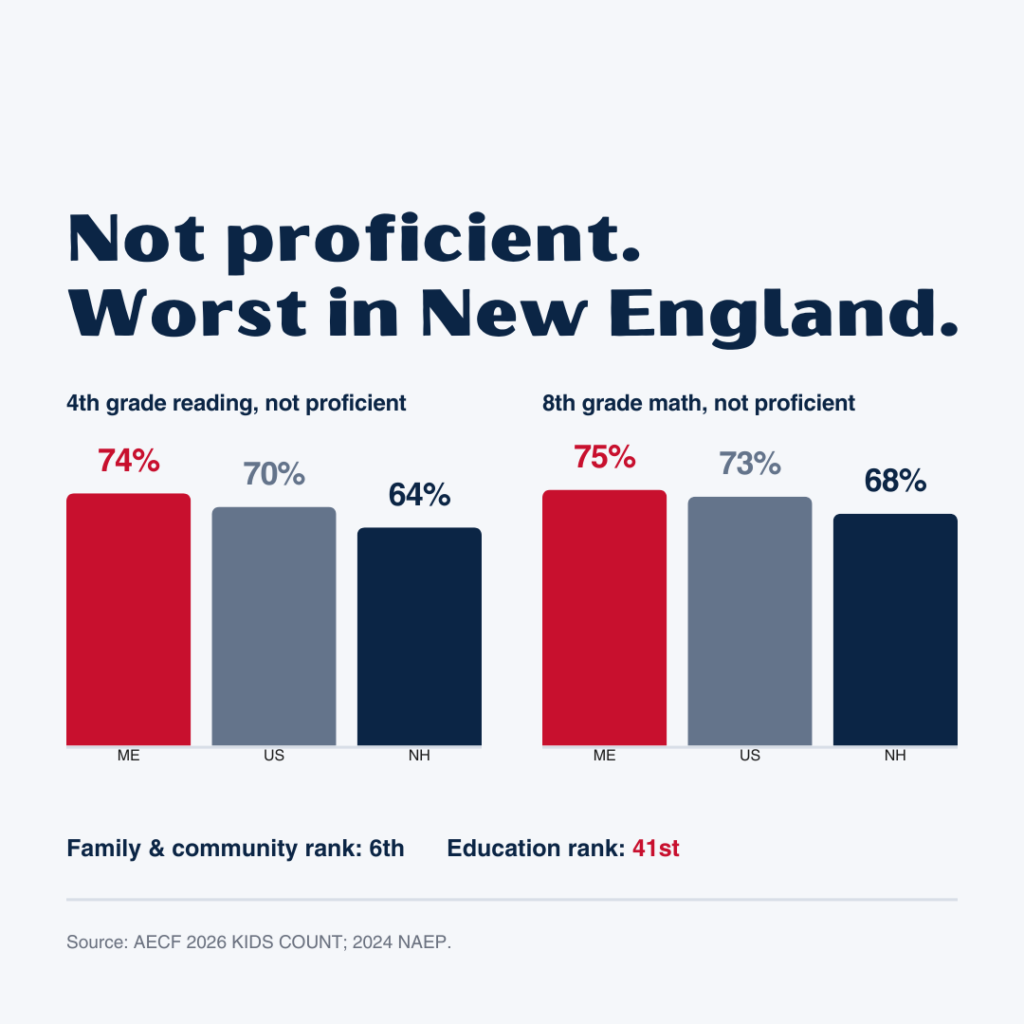
Both gaps are worse than the national average, and worse than every other state in New England. Massachusetts and New Hampshire still beat us on the numbers that show whether kids can actually read and do math.
We still graduate students at a normal rate. The hard question is what that diploma means when so many kids never hit proficiency!
Poverty Doesn’t Explain the Report Card
The 2026 KIDS COUNT Data Book puts Maine’s child poverty rate at 13%, below the national rate of 17%. Only about 2% of Maine kids live in a high-poverty neighborhood, versus 9% nationally. Combined with our 6th-place ranking for family and community stability, the data undercuts the idea that our schools are simply overwhelmed by disadvantage.
Our kids arrive with fewer of the headwinds that usually explain low scores elsewhere. They still finish near the bottom of New England on learning. Something inside the system itself is failing them.
We’re Already Spending Plenty
If you were to guess how much we spend per K-12 student in Maine every year, do you think it would be more or less than the national average of about $16,500?
How much do you think a year of K-12 education would or should cost?
In the last fiscal year, Mainers spent $19,803.88 per student, according to the Maine Department of Education – nearly $20,000!
When a system already spends at that level and so many students still struggle to read at their grade level, the honest question is: who has the power to demand better, and who gets to leave when a child is not being served by their assigned school?
We Fund The System. Augusta Runs It.
Most Maine students are still assigned by where they live. Even with troubling results, Augusta hasn’t broken down these archaic barriers for everyday families.
We have bits and pieces of choice:
- A historic town tuitioning program. EdChoice’s 2026 participation rankings put it at 1,827 students. That means other options for those few families, but thin coverage in a state with about 170,000 kids in public schools across the state.
- Some charter options, with nonsensical limits that should be repealed.
- Homeschool and private school options, for families who can make it work.
What we still don’t have is broad, portable power for parents who are unhappy with the school their zip code handed them: statewide open enrollment with teeth, flexible education accounts or tax-credit scholarships that follow the child, and enough accessible schools that “choice” means more than a slogan.
We fund this system through some of the highest property tax burdens in America, but we don’t get a say in how it’s run. That’s a broken contract and we’re demanding Augusta fix it.
What Education Freedom Means For Us
Lead Maine’s Education Freedom agenda is straightforward:
- Flexible education accounts and family tax credits, so dollars can follow our kids to whatever setting actually works: public, private, tutoring, or something else entirely.
- Statewide public open enrollment, so we can apply to the public school that fits, not just the one inside our district lines.
- Lifting unnecessary charter caps, and letting colleges and universities authorize charters.
- Rolling back mandates that block schools and families from working together.
- A near-term lever with no added state costs: Maine should opt into the federal Education Freedom scholarship tax credit, so private donations can fund scholarships starting with the 2027 contribution year. A July 2026 American Federation for Children analysis estimates 185,394 Maine children, 96.2%, the highest rate in the country, already meet the federal income test. They only gain access if Governor Mills opts Maine in.
Public schools still matter to Maine families. What doesn’t work is forced assignment paired with high taxes and weak results.
The New Hampshire Reminder
Though Maine and New Hampshire share a border, a climate, and a lot of small-town reality, our educational outcomes still diverge sharply.
In the 2026 KIDS COUNT rankings, New Hampshire is 1st in the nation for overall child well-being. We’re 21st. Ten percent more of their fourth graders read proficiently than ours. Eight percent more of their eighth graders are proficient in math.
Our neighbors prove that different policy choices produce different results. We can keep paying top-tier property taxes into a closed system, or we can demand real power and make our schools earn our trust, starting with a no-cost federal opt-in.
What We’re Asking For
Whether directly or indirectly, if you pay rent or a mortgage in Maine, you pay property taxes. Which means you’re already invested in K-12. The only question left is who this system answers to.
Read Lead Maine’s Education Freedom plan and share it with every parent who is tired of funding failure.
Tell your state and local candidates: lift the barriers, open enrollment, expand real options, and stop spending more for worse results.
We fund the schools. We shouldn’t need permission from Augusta to do right by our kids!